
MIG Welding Machine for Rebar Fabrication (NB-350 / NB-500)
MIG Welding Machine for Rebar Fabrication: NB-350 vs NB-500
Rebar fabrication does not end at bending and cutting. Once cages, mats, and precast frames leave the bender, someone still has to weld them — and the quality of that weld determines whether the cage survives transport, lifting, and pouring. The MIG welding machine is the last step in the rebar workflow, and choosing the wrong amperage class costs either money (oversized machine, oversized breaker) or rework (undersized machine, cold lap, porosity).
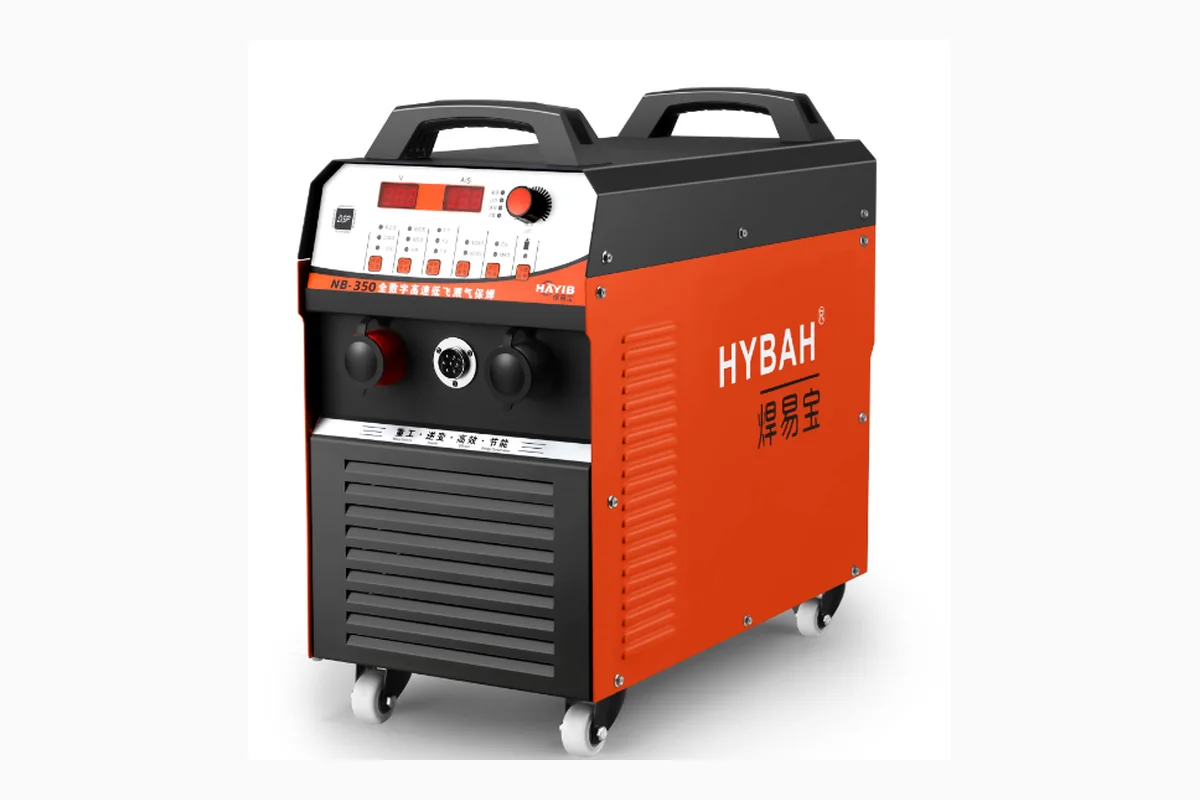
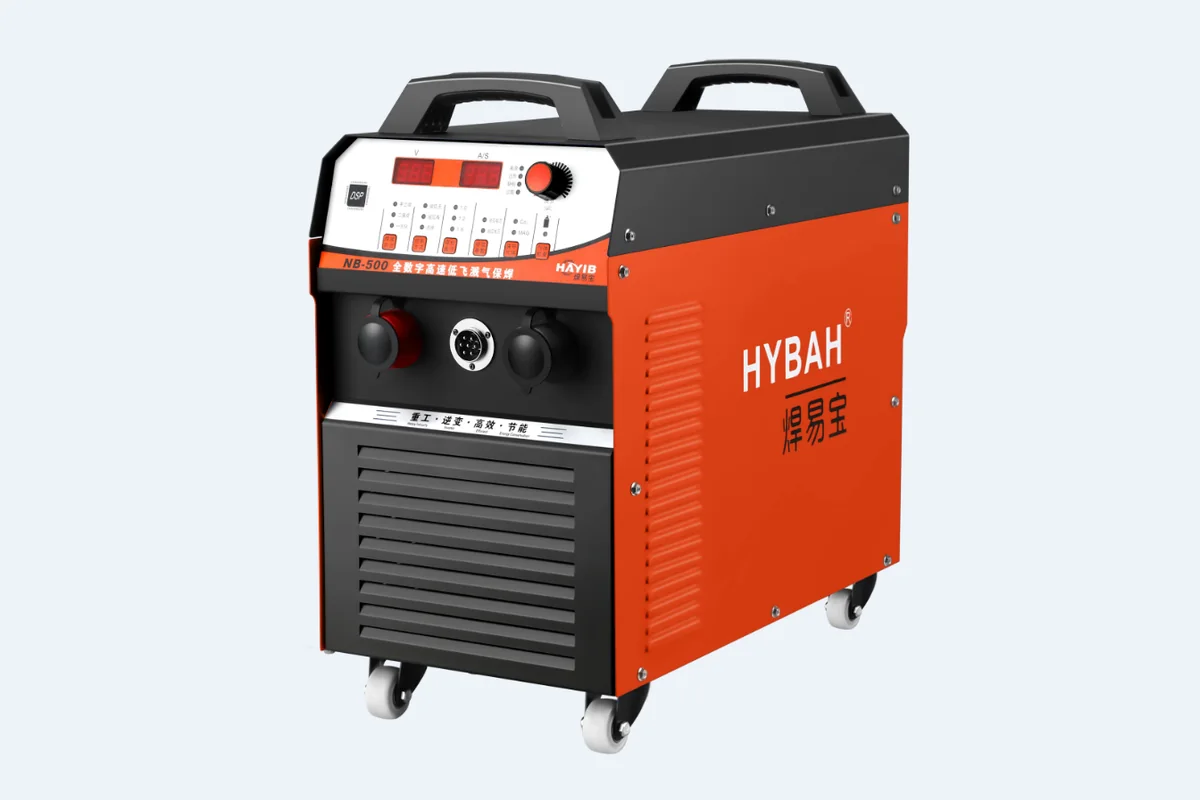
Gongda, the brand behind China Rebar Machinery, builds two CO2 MIG welders for fabrication shops: the NB-350 and the NB-500. Both are inverter-based, gas-shielded units designed for continuous shop duty rather than occasional repair work. Here is how to match one to your production.
Why CO2 MIG for Rebar Instead of Stick Welding
Stick (SMAW) still dominates on-site rebar tying, but in a fabrication shop the economics shift toward CO2 MIG for three reasons:
- Deposition rate. A 350A MIG unit running 1.2mm wire deposits roughly 3–4 kg of weld metal per hour — about double a 4.0mm stick electrode at the same operator effort.
- No slag chipping. On repetitive cage welding, eliminating deslagging between passes is often the single biggest time saving.
- Lower heat input per joint. Controlled short-circuit transfer reduces distortion on thin stirrups and small-diameter ties, which matters when you are welding 6mm and 8mm stirrups to 20mm main bars.
The trade-off is that CO2 MIG needs a clean, dry, indoor environment and a shielding gas supply. For a shop assembling rebar cages, that is normally already in place.
NB-350: The Default Choice for Stirrup and Cage Work
The NB-350 is a 350A-class machine, typically run on 380V three-phase. In practice it covers:
- Wire diameters from 0.8mm to 1.2mm (solid MIG wire)
- Single-pass fillet welds on rebar up to roughly 16–20mm
- Stirrup-to-main-bar tacking, spacer welding, and mesh point welding
- Light structural work — lifting lugs on precast panels, anchor plates, and embed plates
For a shop running a GW25 single-head stirrup bender or a ZD-6M-25 five-head stirrup machine, the NB-350 is usually the correct pairing. Those machines produce large volumes of small-diameter closed stirrups, and the welding that follows is tack-heavy rather than deep-penetration. A 350A unit at 60% duty cycle handles that all day without tripping a 32A breaker.
Practical note: keep the NB-350 on a dedicated 380V circuit. Sharing a circuit with a GQ50A or GQ70A cutting machine invites nuisance trips when the shear fires mid-weld.
NB-500: When You Weld 25mm and Above, or Weld Continuously
The NB-500 steps up to 500A and accepts 1.2mm and 1.6mm wire. It is the right machine when:
- You are welding main bars of 25mm and above, or doing full-penetration butt joints
- You fabricate large-diameter cages — bridge piles, diaphragm walls, tunnel segments
- You run two or more welding stations off one machine, or weld near-continuously through a shift
- You weld in flat and horizontal positions on heavy embed plates and base plates
Shops pairing an NB-500 typically also run heavier bending equipment — for example a GJZD6-65CZ CNC bending machine (up to 65mm) or a GDPMW-60 plane bending center (60mm). If your bender handles 60mm bar, your welder should not be the bottleneck.
Duty Cycle Is the Real Differentiator
Do not compare the two on amperage alone. Compare duty cycle at the amperage you actually weld at. A 350A machine rated 60% at 350A will run comfortably at 250–280A continuously. A 500A machine rated 60% at 500A gives you headroom at 350–400A that the smaller unit cannot match. If your operators routinely weld at 300A or above, buy the NB-500 even if most joints are small — the machine will run cooler and last longer.
Shop Setup Advice Before You Buy
- Power supply. Confirm your available supply. Both units are three-phase 380V; single-phase variants exist but limit output.
- Gas. 100% CO2 gives the deepest penetration and lowest cost per joint, but more spatter. A 80/20 Ar/CO2 mix runs smoother and is worth it if you weld visible architectural rebar.
- Wire feed distance. Keep the torch lead under 3m for 1.2mm wire. Longer runs need a push-pull torch.
- Fume extraction. Rebar often carries mill scale, oil, and sometimes galvanizing. Weld fume control is not optional in an enclosed shop.
- Consumables stock. Contact tips, nozzles, and liner are the three items that stop production. Stock them.
Export, Certification, and Support
Gongda exports rebar processing and welding equipment worldwide, with established shipments to Russia, Spain, Latin America, the Middle East, Southeast Asia, and Africa. EAC certification is available for Russian and CIS markets, which is often the deciding factor for buyers in that region.
The welders sit alongside the full rebar line — CNC bending centers, stirrup benders, arc benders, hydraulic shearing lines, straightening and cutting machines, band saws, thread rolling machines, and automatic spring making machines — so a shop can source the complete workflow from one supplier and one freight consolidation.
For model selection, voltage configuration, or a quote on the NB-350 or NB-500, contact the export team directly:
- WhatsApp: +86 193 9277 7259
- Email: yuhua0095@gmail.com
- Web: chinarebarmachinery.com
Send your typical rebar diameters, joint types, and shift pattern — that is enough to recommend the correct amperage class and wire diameter without overbuying.
Send your requirement on WhatsApp — we reply within one business day.
WhatsApp Request a Quote →
More Articles
Single-Line vs Double-Line Rebar Machines: Which to Choose
Single-Line vs Double-Line Rebar Machines: Which to Choose If you are specifying a CNC rebar forming machine f…
Rebar Machine Electricity Requirements (380V, 50/60Hz)
Rebar Machine Electricity Requirements: 380V, 50/60Hz, and Generator Sizing for Remote Sites Most buyers sourc…
How to Calculate Rebar Processing Productivity
How to Calculate Rebar Processing Productivity: Bends Per Hour, Stirrups Per Shift, and Line Throughput Most b…
Rebar Machine Safety Operation Rules
Rebar Machine Safety Operation Rules: A Practical Guide for Buyers and Operators Rebar processing equipment is…
Rebar Machine Maintenance Checklist
Rebar Machine Maintenance Checklist: Daily, Weekly and Monthly Schedules That Prevent Downtime Every hour a CN…
CNC Stirrup Machine Cost and ROI Calculation
CNC Stirrup Machine Cost and ROI Calculation: What Buyers Should Actually Model When a fabrication shop or reb…
Ready to Talk Numbers?
Send us your rebar processing requirements and get a factory-direct quotation within one business day.